What metrics matter?
Data is the backbone of a Just Enough Marketing Strategy – because the right metrics tell the story of your business… and show you where the gaps and opportunities are to grow.
Especially in times of uncertainty, having quick insight into your business can help you make decisions and adjust your strategy or approach to respond to the moment.
It can also be incredibly grounding.
When it feels like everything is on fire, it’s easy to assume that your business is too. But the story you’re telling yourself might not be the same as the one the numbers are telling.
A past client was constantly spinning out, convinced that her business was failing.
But when we mapped it out and looked at the data – it turned out she was doing fine! Not only was her business growing, she had secured steady income for the rest of the calendar year.
Having that insight gave her the security to start making strategic decisions rooted in alignment with her vision, values and goals – rather than fear.
Doing business online gives you access to an avalanche of data – some of them essential to determining the health of your business and some… not at all.
For data to actually be helpful, identify just enough of the right metrics to drive decision making and strategy without it becoming an overwhelming or anxiety-inducing task on your already full to-do list.
What metrics matter most is going to vary greatly from business to business and largely depends on factors such as:
Your business model
Phase or stage of your business
Your business goals
While deciding on what to track is deeply personal to you and your unique business, there are three core metrics that every business owner should be tracking, regardless of variables:
💰 Revenue
Are you on track to hit your goals? Yes, great! No, you may need to shift your strategy or approach.
📈 Cash Flow Forecast
Knowing when money’s coming in is the true business security blankie. Also great for planning - if you know you’re fully booked out until July, don’t wait until June 27th to start campaigning!
🔎 Referral Sources
Simply asking “where did you hear about us ” will tell you a lot about what marketing strategies are working, fast.
Together, these three metrics can give you the 1,000 foot view of your business and a quick health check.
But just like how your blood pressure reading isn’t the full picture of your health, these numbers aren’t either.
What metrics tell the story of your business?
Consider what matters most to your business. Where do sales happen?
If it’s through discovery calls, tracking the number of conversations you have each week/month/quarter may be insightful. How many proposals have you sent out? And how many of them moved forward vs. went cold?
If you’re running a community, you might look at memberships, cancellations and renewals.
For Substack writers, paid subscriptions.
When it comes to marketing analytics, it’s tempting to get caught up in vanity metrics like followers or subscribers.
But unless you’re generating revenue through brand partnerships, it’s unlikely that these numbers matter much.. If at all.
An email list with 1,000 subscribers with zero sales is meaningless next to a list of 100 that sold out a group program.
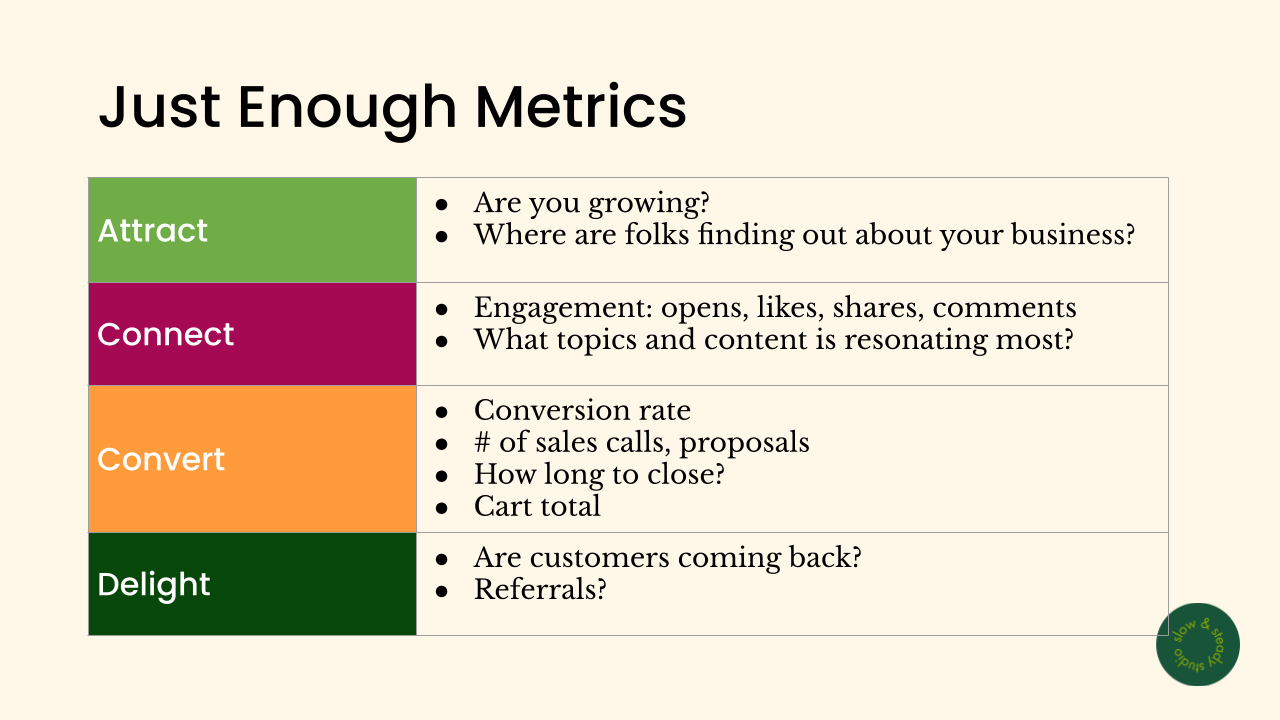
The best marketing metrics to track are the ones that align with your current objectives and align with each layer of a marketing sandwich:
One last thought.
I’ve heard from many creative entrepreneurs that they avoid looking at data and analytics for fear of it meaning something… about them.
And while tracking metrics can absolutely give you important insights into your business, at the end of the day they’re just numbers. Data is neutral.
How many hits you got to your website last month or how much money you’ve made so far this year has nothing to do with you or your worth as a human being. 💖